
Swistra, the Ripple Control of the 21st Century
What is Swistra?
- Swistra is a completely new developed transmission method.
- Swistra is an evolution for an existing Ripple Control system.
- Swistra is a byte pattern composed of a command byte and three address bytes.
- Swistra is backward compatible with known Ripple Control telegrams.
- Swistra is the Ripple Control of the 21st Century.
Why switch to Swistra?
- Swistra has higher data rate than other bit patterns.
- Swistra has shorter telegram runtimes than other bit patterns.
- Swistra has a very large address space.
- Swistra can address each recipient on its serial number individually.
- Swistra can be used without a conversion phase.
Swistra – flexible control!
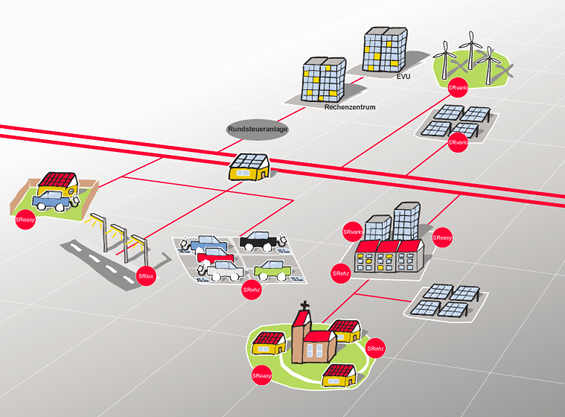
With Swistra loads and generators can be controlled with a customizable group address structure, for example according to minisubs. Moreover each Swistra receiver can be controlled individually. The group assignment can be reprogrammed with a dedicated Swistra command via a Ripple Control transmission:
Swistra – how do I change?
- Upgrade the control system. Swistec RKS-controllers only need a firmware update to achieve this.
- Most static transmitters can be retained. Rotating transmitters need to be replaced (e.g. with a Swistec SRS-3xxx transmitter).
- Installation of receivers for the desired new tasks.
Swistra – what remains the same?
- Compliant and compatible with all existing Ripple Control systems / bit patterns.
- Using the same frequency as the existing Ripple Control system.
- Using the same coupling cells as the existing Ripple Control system.
- Most static transmitters can be retained. Rotating transmitters need to be replaced (e.g. with a Swistec SRS-3xxx transmitter).
- Using all existing receivers in a mixed mode.
Swistra – receivers from Swistec
All Swistec ripple control receivers use state-of-the-art, recently developed filter algorithms capable of reliably processing ripple control signals with operating voltages below 0.3% Un – a result of state-of-the-art processor technology combining high CPU power with little power consumption.